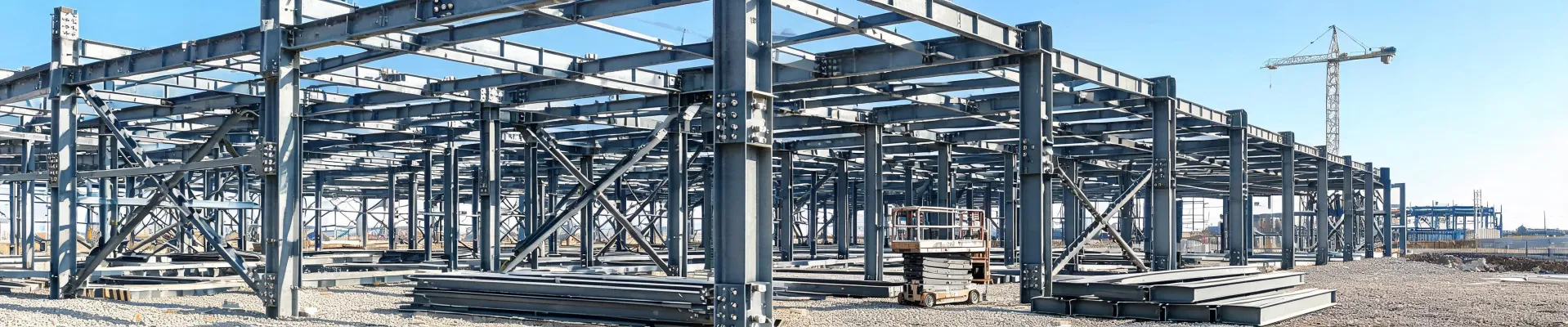
A facilities procurement story from a mid-size equipment rental company: why the lowest steel building quote turned out to be the most expensive option, how we rebuilt our evaluation around total cost of ownership, and the checklist we use now for modular steel structure and PEB building purchases.
-
The project showed up on a Friday afternoon
-
I collected four quotes and felt pretty good about myself
-
The thing I was really paying for, and didn't know it
-
The first red flag showed up as a PDF
-
Where the money actually went
-
The number I should have calculated in March
-
What I do differently now
-
Where this advice stops applying
The project showed up on a Friday afternoon
In March 2023, our operations director dropped a folder on my desk at 4:40 on a Friday. It was a facilities expansion project — a 4,800-square-foot modular steel structure building to serve as equipment storage plus a small dispatch office on the back lot of our yard.
I manage purchasing for a 160-person equipment rental company. Normally I'm buying uniforms, IT gear, forklift consumables, that kind of thing. Buildings were new territory for me. The last time the company put up new structures, they used a general contractor and let me sign the invoices. This time they wanted me to run the process.
Rough budget: $150,000. Deadline: our lease on an off-site storage unit ended in November, and the whole point of the project was to stop paying $2,300 a month for that space.
I collected four quotes and felt pretty good about myself
By mid-April I had four options on the table:
- A local general contractor doing a conventional steel building — $152,000, 16-week lead time, one point of responsibility.
- A regional PEB building manufacturer quoting a pre-engineered building direct — $118,000, 18 weeks, but I'd have to line up foundation work and erection separately.
- An overseas factory I found through a sourcing platform, quoting a modular steel structure building — $89,000 FOB, plus freight, 20 weeks.
- A procurement service that matched us to overseas suppliers and quoted landed, delivered, with drawings pre-reviewed — $106,000, 12–14 weeks.
To be fair, I didn't understand the differences between those options nearly as well as I thought I did. I'd read up on conventional steel building vs pre engineered comparisons and concluded that conventional was overkill for a storage building. Fine. That part of my reasoning held up.
Then I did the math I thought was the math: $89,000 versus $106,000. A $17,000 gap on a $150,000 budget. That felt like a no-brainer. Why would I pay a middleman $17,000 to do things I could do myself?
The thing I was really paying for, and didn't know it
Here's the rookie mistake, and it's a classic: I treated the FOB price as the price. FOB means the goods are on the ship at origin. Everything after that — ocean freight, port handling, duties, customs brokerage, inland trucking, the crane at the end — was going to be "arranged separately." I knew that in theory. I did not price it out properly.
I also assumed the factory would produce something that met our drawings. The quote said "per drawings provided." What it did not say was whose drawings, reviewed by whom, and against what tolerance.
The first red flag showed up as a PDF
Six weeks after the deposit, I got a drawing package for approval. Two things jumped out. The anchor bolt pattern was laid out on a metric grid — standard practice for that factory — and our foundation contractor had already poured the footings on an imperial layout from the site plan. Second, the bracing assumed a clear span on the front wall, but I'd asked for an overhead door opening in roughly that location.
Translation: the building was fine. The building was never going to fit what we'd already built.
I want to be honest about how that landed internally. The foundation crew had to come back and re-core two footings. I spent the better part of a week on calls that started at 6:30 a.m. every day to catch the factory team before they clocked out. The most frustrating part of the whole thing wasn't the money — it was explaining to our VP of finance, for the third time, why the "cheap option" kept generating change orders.
We got it resolved. The building went up in September instead of August. It's structurally fine and the yard team likes it. But it was not $89,000.
Where the money actually went
Here's the honest reconciliation, roughly, from our AP ledger. Take this with a grain of salt on the small lines — I rounded some of the phone and travel charging:
- Factory quote, FOB: $89,000
- Ocean + port charges, freight forwarder: $7,400
- Customs brokerage + duties + bond: $6,900
- Independent structural engineer to review drawings and re-detail the anchor layout: $2,800
- Foundation rework (two footings, rebar, inspection): $9,600
- Crane and erection coordination (which I thought was in the factory quote and was not): $4,200
- Four extra weeks of the off-site storage lease we were trying to kill: $6,400
- Rush shipping on two components missing from the container: $1,300
Total landed: about $127,600. Against a $106,000 delivered-and-reviewed quote from the procurement service. And against a $118,000 pre-engineered quote that would have been assembled by a crew that had done thirty of them.
Don't hold me to this, but I think the true delta was somewhere north of $20,000 once you count my own time. I logged 40+ hours on this that I did not log against anything else on my plate.
The number I should have calculated in March
What I learned the hard way is that the invoice price is basically an entrance fee. The real number is total cost of ownership, and for prefab and modular steel construction it usually breaks down like this:
- Purchase price — the quote itself.
- Logistics — freight, port, drayage, crane, storage.
- Duties and compliance — brokerage, tariffs, import bond, certification of steel mill test reports.
- Engineering reconciliation — whoever translates drawings between the factory's convention and your site's convention. Someone has to do this. Either you pay them or you become them.
- Site rework — the number that should be zero and almost never is.
- Schedule cost — every week of delay has a number attached to it, whether it's a lease you're still paying or revenue you're not booking.
- Internal time — your hours, and your team's.
Bottom line: the cheapest line item in a spreadsheet is very often the most expensive line in the ledger. That's not a clever saying, it's just arithmetic I ignored.
What I do differently now
Two other things have changed since. First, I now ask every supplier — domestic or overseas — to quote landed and installed, not FOB, not ex-works, not "delivered to site, crane not included." If they can't quote landed, I price the remainder myself before I compare anything. Second, I ask specifically who reviews the shop drawings before fabrication, and I get it in writing.
In 2024, when we looked at a second building, I leaned much harder on suppliers who already handled wholesale sourcing and supplier matching as their actual business — the procurement partner I'd dismissed the year before, and a couple of options in that same lane. The number on their quote was higher from day one. The number at the end of the project matched it almost exactly, which I now understand is the whole point. I'm not saying they're right for every project. I'm saying their quote was the only one that didn't move.
Where this advice stops applying
I can only speak to our situation: one buyer, a $150,000 budget, a fairly simple clear-span storage building on an existing yard, and a domestic site where I had a general contractor on speed dial. If you're a developer running multiple buildings a year with in-house engineering review and an import compliance team, the economics of direct overseas sourcing might genuinely work in your favor. I've never been in that position.
My experience is also based on exactly one overseas direct purchase, which is a sample size of one. That's not a market insight, that's an anecdote with receipts. Your mileage will vary based on your site conditions, your team's bandwidth, and how much of this you've done before.
But the general principle — calculate the whole number, not the quote number — has held up on every purchase I've made since, from a $60,000 HVAC replacement to a $6,000 pallet of uniforms. It's just easier to ignore when the number is small. It's really expensive to ignore when the number is a building.